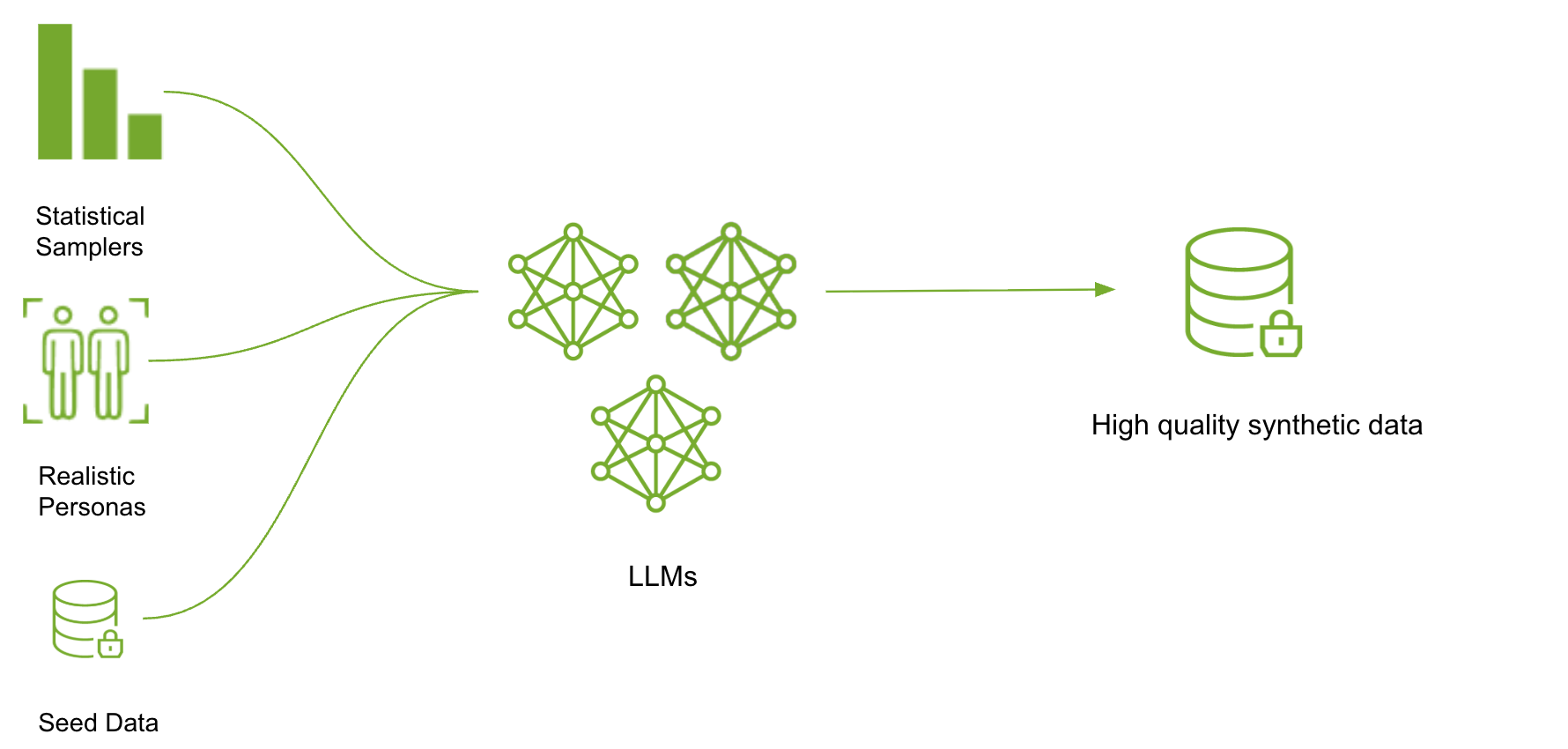
NVIDIA’s September 15 NeMo Data Designer paper describes synthetic-data generation as a configurable system, rather than a single instruction to produce more text. Its open-source repository lists an October 5 software release. Together they highlight a model-development problem that grows with cheap generation: making a million records is less useful than knowing what distribution those records represent. The paper sets out the architecture; the release history establishes the software’s recent activity.
The dataset has relationships, not just rows
The framework lets users define columns, dependencies and generation stages. The paper describes supported forms including text, code, images, embeddings and statistical samplers, with a preview-and-revision loop before larger runs. This matters because a useful example often contains fields that must agree. A question, its evidence and its answer cannot be sampled independently and assumed to form a sound training record.
Consider an illustrative dataset for learning to interpret equipment reports. A generated fault description should match the component identifiers and supporting observations. If the answer requires a measurement that the input never supplied, the record may teach unsupported certainty. Formatting can be correct while the learning signal is wrong. A schema provides a place to express that relationship, but it does not discover the correct relationship automatically.
Validation becomes part of the curriculum
The project documentation describes validation through code, custom checks and model judges, alongside dependency-aware generation and external tools. Those mechanisms can reject malformed or inconsistent outputs. They also create a consequential choice: whatever passes the filters becomes the behavior the training process repeatedly sees.
Our assessment is that teams should treat validators as model-development decisions. An overly narrow check may remove legitimate alternative answers. A permissive check may retain polished mistakes. If one language model generates examples and another scores them, their agreement can still reflect shared blind spots. Human review of a deliberately varied sample remains useful for deciding whether automated checks are measuring the intended property.
The economics are in acceptance, not output
A synthetic-data budget should separate generated records from accepted records and accepted records from beneficial records. The first measures throughput, the second measures filtering, and the third requires a training comparison. A cheap generator can become expensive if most outputs need rejection or if the remaining data fail to improve the target capability.
A sensible experiment would hold the base model, training budget and evaluation set fixed while comparing a real-data baseline with several synthetic mixtures. The team should retain the generator version, prompts, sampling settings and rejection reasons. Those artifacts help explain why a later rerun changes performance. Reproducibility is especially valuable when a business must maintain a specialist model through repeated updates.
The recipe can outlast the generating model
The less obvious asset is a portable dataset specification. If a company has clearly defined its tasks, field dependencies and acceptance tests, it can compare generating models without redesigning the entire workflow. That may reduce dependence on a particular teacher. The benefit is conditional: changes in model behavior can still alter distributions and require new validation.
The opposite risk is building an apparently objective factory around undocumented judgment. A dataset can look systematic while its task balance merely reflects the assumptions of whoever wrote the first prompt. Before scaling, a business should ask which real failures motivated each category and which categories remain absent. Generation can magnify a well-designed curriculum; it can also industrialize an arbitrary one.
Do not confuse the library with the old service
There is an immediate operational distinction. NVIDIA’s legacy microservice listing says NeMo microservices were sunset on October 1, 2026, with no new releases. That notice is not a claim that the separately maintained open-source Data Designer library has stopped. Buyers evaluating support and deployment should identify the exact component rather than rely on the shared name.
The commercial opportunity is credible but specific: make the creation of model-training examples inspectable and repeatable. The framework is infrastructure for conducting that work. The outcome still depends on whether the designed examples help a model handle evidence it has never encountered before.
The evidence to watch
Look for controlled model-training comparisons, acceptance rates, documented dataset mixtures and reproducible configurations. Track whether gains persist when the generating model or business data changes.
References
Questions, news tips or corrections? Contact [email protected].